
Watch the video of the November 20, 2025 meeting on YouTube.

The meeting was called to order at 7:30 pm. Michelle Koval led the Pledge of Allegiance, followed by the reading of club’s Mission Statement by Jim Strawhorn. Regina Faighes read the minutes, and Arkadiusz Tomaszewski gave the financial report. Martha Rowen delivered the Nominating Committee’s report. Ilan Riss gave his first hand account of the Israeli hostage history and status. Svetlana Zelinskaya, the newly elected First Vice Chairman of the Kings County GOP painted a picture of what Republicans need to do.
Sophia Worrell’s note cards which summarized what she observed from Democrats.


Notes shared from a Mamdani volunteer. Quick disclaimer: my experiences may not be universal as I (the volunteer) only volunteered in one part of Queens and two areas in Brooklyn.

Ground level volunteering was facilitated through the campaign website, which had a map function and zip code lookup that made volunteering for specific areas and at specific times very easy. As best I can tell, schedules during the primary leading up to the final weeks were largely based on field lead scheduling, not on the direction of the campaign. The campaign supported efforts in target areas but my impression was that if no field leaders were available, no canvassing would occur. The area that I did in Queens was an example, having only one or two weekly canvasses in the afternoons or evenings on Fridays due to the field leaders only being available at those times.
Each canvass zone had a dedicated group chat run primarily by the field leads to coordinate events, pass along overarching campaign information, and foster some degree of community between canvassers. Things like meeting places, announcements, changes, and real-time Q&A for canvasses. I was in, but not active in, those chats, but my impression was that they helped to foster engagement and retention to some degree. Field leads would also generally reach out to people who had signed up to canvass at least several hours, if not a day, before their scheduled shifts.
New canvassers were generally kept behind for training on their first shift, though I never had this due to my first canvass being sparsely attended. This training seemed to take around 30-60 minutes and covered the general pitch, specific Q&As that might arise, etiquette, canvassing laws, etc. New canvassers would be paired and generally canvassers operated in pairs, though more experienced canvassers could and, especially in large canvasses were encouraged, to go alone. The pairing allowed for canvassers to bond and also reduced the stress/anxiety of some canvassers knocking on doors, especially in areas where they could expect language barriers.
The actual canvassing was done via the app Minivan, which was relatively simple to use. Marking doors down with a tap of a button for contact, no contact, degree of support, as well as the ability to add informative notes for future canvassers (eg confirmed language, outdated voter registration, someone who would not be voting for any Democrat, etc), was a massive help and allowed for quicker door knocking.
Operations were helped by having zone-specific literature. There were many times where I would encounter persons who had limited English, and having the option of language-specific literature helped to reduce the chance of a no-contact knock (the “no contact” option included instances of the door being opened and shut quickly). In some areas I would have up to 5 different flyers, each with an English side and a different language.
We were encouraged to complete lists but since canvassing after a certain time is not allowed, there was never any external pressure to push ourselves to finish a list. If a list wasn’t finished, it would simply be given to the next shift. In the evenings, there was generally a rally point where canvassers could get drinks, eat, and socialize with each other, which helped to keep morale high and likely helped retain canvassers. On my first canvass, the lead bought each canvasser (there were only 3 of us that time) a drink and we chatted for an hour. On other canvasses, especially in the last few weeks, field leads would provide water to canvassers starting and ending shifts.
I generally did evening shifts as that was most conducive for my schedule most times and, given the heat, most comfortable. They also had higher hit rates, as both parents and children would generally be home leading to increased chances of a door being opened and thus to pass on literature or have a conversation.
I joined relatively late in the primary campaign so I can’t say whether my observations are totally consistent with the campaign at large, and I was unable to participate in the general campaign for several reasons. But the effort was consistently high morale and energetic. While demographics tended towards the young, I saw many older people (including, one time, someone in their 70s) participating. Some mothers had their young children with them. Everyone had a strong sense that they were not only a part of something greater and more important than themselves, but that they had a real chance of actually making a difference. I think by the late spring the campaign benefitted from people increasingly feeling like the harder they worked, the more likely their efforts would succeed. Seeing more and more people show up to canvasses was encouraging and field leads always emphasized that swelling numbers (among other canvassing statistics) were a sign that we were having an effect.
I should stress that the issues, or at least emotions surrounding the race, were just as important. Each canvass would start with an introduction, how long you had been canvassing, and what policy or issue was most important to you. Housing costs were the main issue I heard, though I heard all of the main campaign planks listed at one point or another. But people would often link specifics to more general things, like “I am here because of housing AND because I want to show that people are unhappy with elites” or “Bussing AND I hate Cuomo and think he doesn’t care for us”, etc.
The general impression I had was that people linked many issues in the city not to the government itself, but rather the non-partisan wealthy elite they perceived as controlling the city’s politicians and preventing the policies that the people actually wanted from being implemented. Universally they rejected Republicans for being the party of wealthy elite, Donald Trump, Rudy Giuliani, and over-policing. But they hated Adams and Cuomo just as much because they were perceived as being the same as Republicans by virtue of their inaction, scandal, wealth, and refusal to listen to more radical solutions. In Mamdani they saw someone untethered to traditional Democratic alliances (such as the Israeli lobby), a demonstrated supporter of the changes they wanted to see, and a youthful champion in a political world dominated primarily by people who can personally remember the end of the Cold War over 30 years.
I think that the campaign machinery really harnessed this hunger for change in effective ways. I don’t know what campaigns were like before, but I was routinely reminded by experience that I was working with people just like me. The field leads and canvassers were people much like me; some unemployed, some with part time jobs or full-time jobs, some in school. I’m not certain, but I’m fairly confident that many of the field leads weren’t even paid, just doing it because they believed. I never met Mamdani myself, only saw him once at the back of a rally, nor did I ever meet any campaign bigwigs or party elites to give long, empty speeches. It felt like a real grass-roots movement and that everyone was excited by not just to get him elected to create change, but to show defiance to the larger, stagent political order.
I think that my biggest takeaway is that people are extremely agitated about not just specific issues like safety or housing or public services, but the environment that those issues appear in. I felt like there was a consistent undertone of betrayal and anger at the larger political environment, which promised that if we all just kept following certain rules then most of us would succeed. But everyone I met seemed to believe that the system was fundamentally broken for everyone who wasn’t at the top. One person I heard at a canvass said something like “I support Mamdani because if he succeeds then things will be better for everyone. If he fails, then nothing will change. But if I support Cuomo, then I know nothing will change.” And I think that sums it up best; a lot of people desperate for something to change and willing to try something new to achieve it.
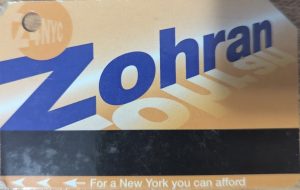
Something that I can’t really comment on but may still be worth discussing at the meeting is the role of novel engagement strategies, or novel versions of older strategies. I am not on TikTok nor do I activately use other forms of social media, but I understand that Mamdani excelled in using them to connect to young people and mobilize them to not only vote but register new voters and drive turnout. Many people I met said they found him via social media or through a friend sharing some via social media (as you know, I read traditional news and picked him because it seemed like the best place to get experience). I can comment on the Zetrocard, which was a card that, upon collecting 10 stickers (one for each canvass), guaranteed a free poster. Personally, I found this highly engaging as the campaign did not have paid merchandise and I wanted a piece of history.

November 4, 2025 meeting email.
November 15, 2025 meeting email.
The next meeting is December 18, 2025. Candidates running in 2026.
thank you so such for the invite
I enjoyed watching on YouTube tube great meeting
I enjoyed watching on YouTube tube great meeting.Very informative. WHAT IS THE DATE OF YOUR NEXT MEETING IN, DECEMBER, THURSDAY? THANK YOU DENISE